Primary Muscle Groups Targeted by Overhead Press
The overhead press primarily targets the deltoid group, which acts as the main driver throughout the movement. Anterior and lateral deltoids bear most of the load to broaden and define the shoulders, while posterior deltoids stabilize the movement to maintain balanced shoulder development and avoid muscular asymmetry. Varied press forms can adjust muscle activation to further strengthen weak shoulder regions.
The triceps brachii serve as the key synergistic muscle, assisting elbow extension and gaining notable strength and hypertrophy. It also activates the upper trapezius and serratus anterior to stabilize scapular movement. Additionally, core muscles engage isometrically to fix the torso, preventing body sway during standing pressing motions.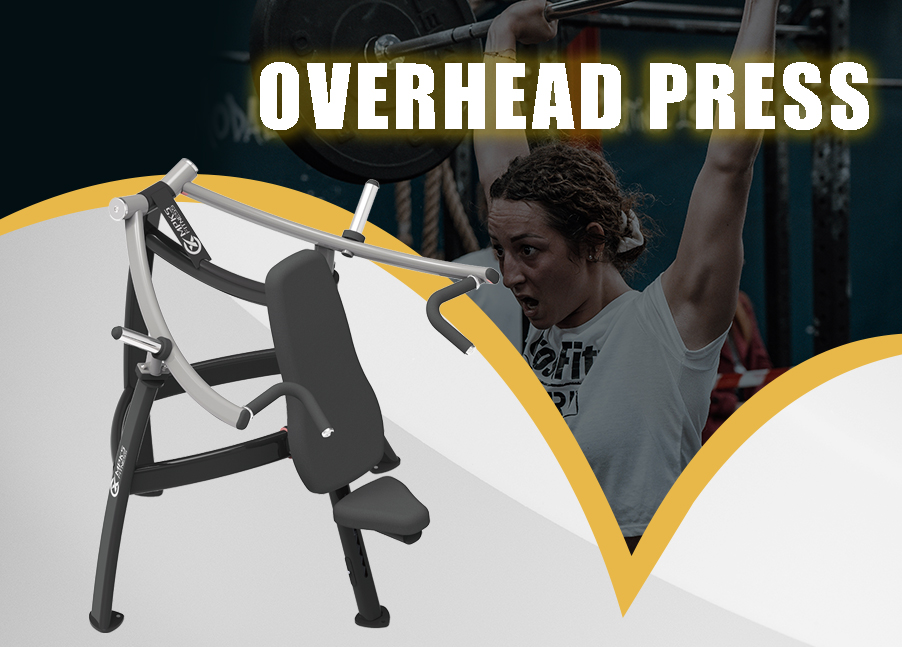
Core Functional Advantages of Regular Overhead Press Training
A core benefit of the overhead press is building functional upper-body pressing strength. This vertical compound movement boosts upper-limb power and explosive force, effectively improving athletic performance in weightlifting, throwing and daily physical activities. It lays a solid foundation for overall upper-body strength gains.
This exercise aids posture correction and injury prevention. It strengthens weak shoulder stabilizers and upper-back muscles caused by sedentary lifestyles, improving rounded-shoulder postures. By enhancing shoulder joint stability, it lowers the risk of strain during other upper-body training movements.
As a multi-muscle compound movement, the overhead press stimulates efficient muscle growth. It triggers greater muscle protein synthesis and fitness-related hormone secretion than isolation exercises, enabling trainees to build upper-body muscle mass and refine body lines with high time efficiency.
Unique Training Value in Systematic Fitness Programs
The overhead press is a key benchmark for evaluating comprehensive upper-body strength. Unlike fixed-path machine presses, free-weight versions require active balance and stability control, greatly improving neuromuscular coordination and body awareness. It delivers functional strength that applies to real-life movement scenarios.
Highly flexible in training design, it adapts to diverse goals: light, high-rep sets build muscle endurance and definition, while heavy, low-rep sets maximize absolute strength. It fits seamlessly into beginner full-body workouts, upper-body split training and professional strength conditioning programs.
To conclude, the overhead press is an essential compound exercise with multi-dimensional training value. It strengthens key upper-body muscle groups, builds functional strength and improves body stability and posture. For all fitness practitioners, it remains a core movement for developing a stronger, more balanced and aesthetic upper-body physique.


